

Applications / Four pressures
Where deliberate data infrastructure matters.
Not every information problem requires new data infrastructure. It becomes important when information needs to move beyond the system it was created for, particularly when it must be used by AI, shared across modern systems, retrieved quickly or relied upon with a high degree of accuracy.
See the four conditions01 / Orientation
When integration stops being enough
Information becomes infrastructure when other systems must depend on its meaning.
Information can often remain inside the application that created it. The need changes when it must travel, answer unfamiliar questions or support decisions beyond that original context.
The four conditions below explain where ordinary data integration becomes fragile and deliberate identity, structure, context and access become increasingly valuable.
02 / Problem field
Four conditions
Four pressures increase the cost of unclear information.
-
01
AI needs context it can rely on.
AI can work across far more information than a person can, but that makes the quality of its underlying context increasingly important. Access to records is not enough: an intelligent system needs enough structure to understand what the information refers to, how records relate and where the information came from. DDI constructs the infrastructure that makes organisational and external information more usable by intelligent systems.
Explore AI context -
02
Modern systems need information to move.
Organisations increasingly operate across APIs, cloud applications, GIS, operational software, analytical environments, external data providers and automated workflows. Those systems often identify and structure the same information differently. Deliberate data infrastructure creates a reliable layer between them without requiring every underlying system to use the same schema or identifier.
Review system boundaries -
03
Some answers cannot wait for someone to search.
Many organisations can find the information they need eventually. A person may search several systems, compare records, resolve different identifiers and assemble an answer manually. That becomes a problem when software or operations need the answer in seconds.
See the operational example -
04
When accuracy matters, provenance matters.
Some decisions can tolerate approximation. Others cannot. When information supports infrastructure, government, operations, engineering, financial decisions or automated systems, it may be important to know exactly what a value refers to, where it came from, whether it is current and whether another source says something different.
Understand reliable context
03 / Why now
A compounding requirement
More reach. Less time. Less tolerance for ambiguity.
-
AI
increases how much information can be used.
-
Modern systems
increase how far information travels.
-
Speed
reduces the opportunity for human interpretation.
-
Accuracy
reduces the tolerance for ambiguity.
04 / At the point of use
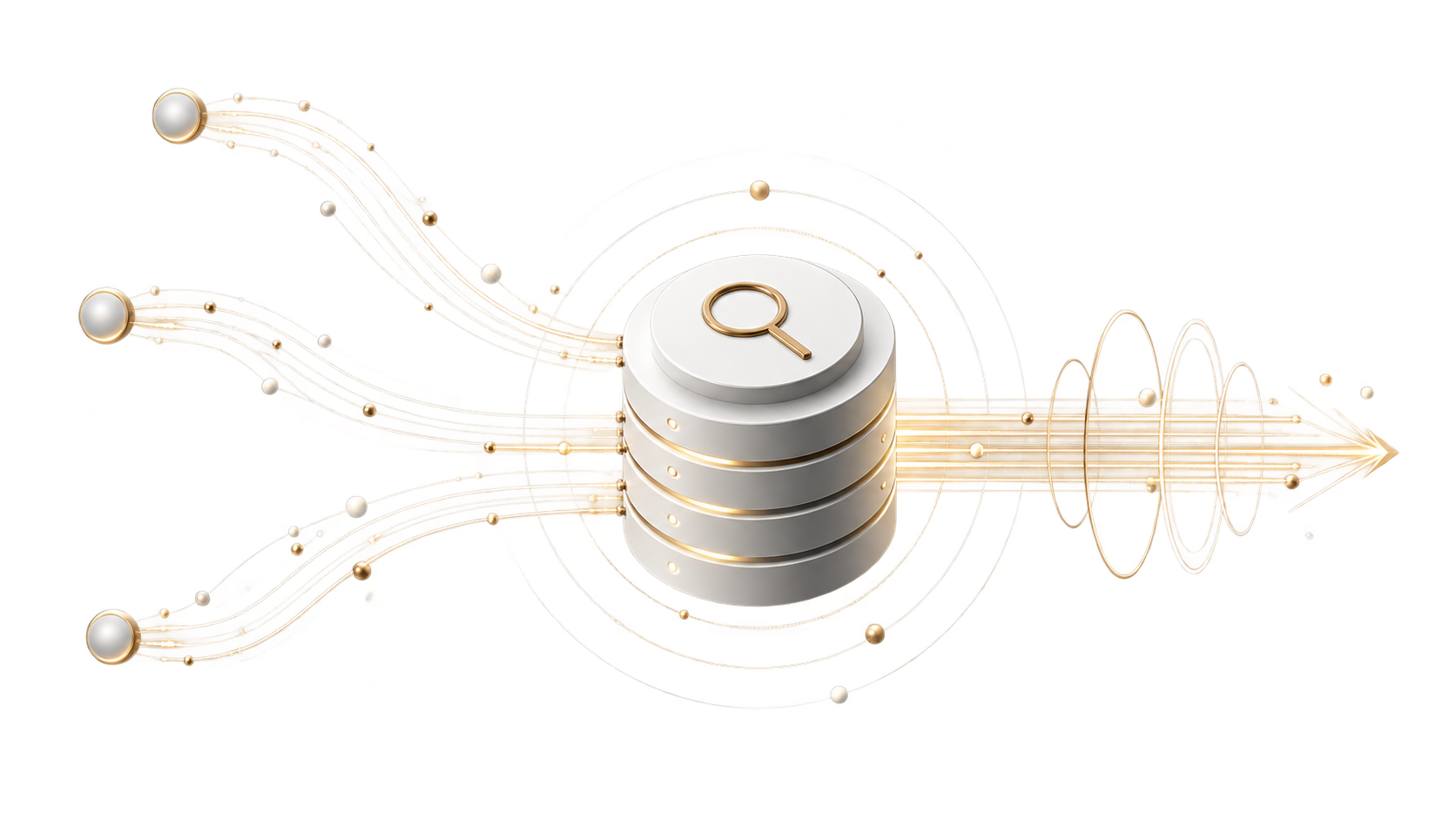
Speed is an information condition
Some answers cannot wait for someone to search.
Deliberate data infrastructure makes important information structured and discoverable before the question is asked, reducing the work required to assemble context at the point of use.
Emergency response is an extreme example: relevant information about a location and surrounding infrastructure may need to be discovered immediately rather than manually assembled from separate systems.
05 / Case study
DDI demonstrated in the physical world
V0: deliberate data infrastructure applied to the physical world.
V0 is the case study for DDI’s approach.
The same road, building, pipe, pole or other physical object may be represented across different systems and providers using different identifiers, geometries, classifications and records.
V0 resolves those representations around persistent physical objects while preserving what each source says and where that information came from.
The result is physical world information designed to be queried by existing software, GIS platforms, enterprise systems and AI without requiring the underlying sources to become one system.
Explore V0Continue / Explore
Follow the condition that matters